The Dolomites are easy to admire in photographs and surprisingly complicated to experience well in a limited amount of time.
On a map, places such as Lake Carezza, Passo Pordoi, Val Gardena, Cortina d’Ampezzo, Tre Cime di Lavaredo, Lake Braies and Seceda can look like a straightforward collection of stops. On the ground, however, mountain roads, high passes, seasonal cable cars, parking limitations and long distances between valleys can turn a sightseeing day into a constant exercise in navigation.
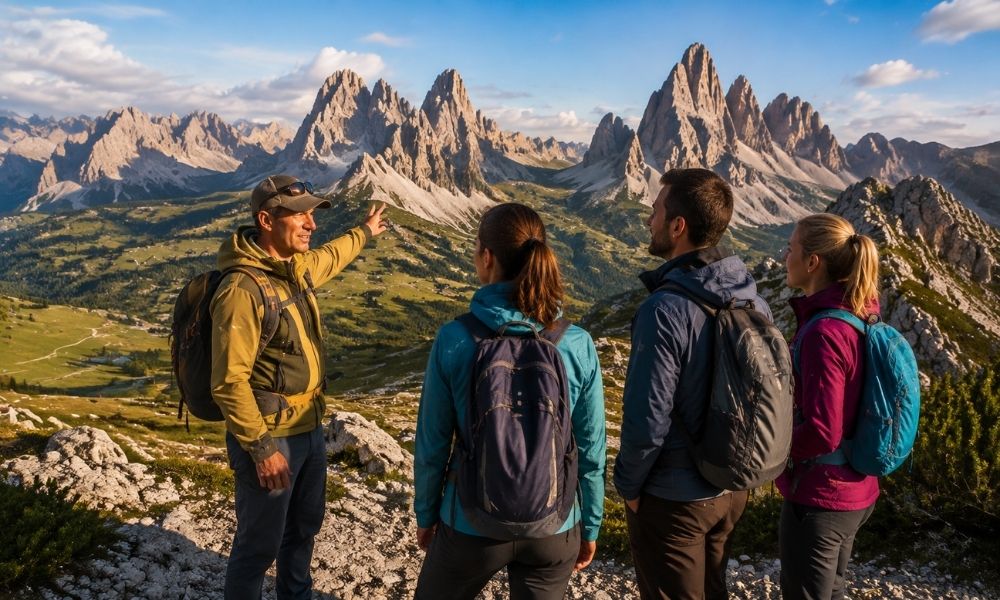
That is where exploring the Dolomites with a local guide makes a meaningful difference. It is not simply about having someone tell you where to go. A knowledgeable local can connect the landscape into a logical journey, explain what you are seeing and help you spend your valuable time experiencing the mountains instead of managing logistics.
For visitors starting in Bolzano, private Dolomites tours with a local driver-guide can be an especially practical way to see more of South Tyrol and Trentino while keeping the day comfortable and personal.
1. A Local Guide Turns a Complicated Map Into a Coherent Journey
One of the biggest challenges when planning a Dolomites day trip is deciding what actually fits together.
The region is divided by mountain groups, valleys and passes. Two attractions that appear relatively close on a map may require a much longer drive than expected because there is no direct route through the mountains. Choosing the wrong order can mean unnecessary backtracking and less time at the places you came to see.
A local guide already understands how these valleys connect.
For example, a journey through the western Dolomites can naturally combine the Ega Valley, Lake Carezza, the Fassa Valley, Passo Pordoi, Passo Sella and Val Gardena. An eastern route works differently, connecting mountain passes with Cortina d’Ampezzo and the lakes around Misurina, Dobbiaco and Braies.
The benefit is not simply covering more kilometres. It is creating a day that feels like one continuous experience rather than a collection of unrelated GPS destinations.
2. You Spend More Time Looking at the Dolomites and Less Time Managing Logistics
Driving through the Dolomites can be spectacular, but the driver often sees less of the scenery than everyone else.
Mountain roads demand concentration. There are switchbacks, changing speed limits, cyclists, buses, busy villages and high-altitude passes. Then there are practical questions at each destination: Where should you stop? Which viewpoint is worth the detour? How long can you realistically stay without compromising the rest of the day?
With a local driver-guide, those decisions no longer dominate your attention.
Instead of one member of the group spending the day watching the road and checking navigation, everyone can enjoy the landscape together.
A guide can also help account for practical details such as:
- Seasonal Operation Of Mountain Lifts And Cable Cars;
- Parking Pressure Around Popular Attractions;
- Realistic Travel Times Between Valleys And Passes;
- Sensible Stopping Points For Photographs And Short Walks;
- The Amount Of Time Worth Allocating To Each Destination;
- Alternatives When Conditions Make The Original Plan Less Rewarding.
This becomes particularly valuable on a full-day journey where a small planning mistake early in the morning can affect several later stops.
3. Local Knowledge Helps You Understand What You Are Actually Seeing
The Dolomites are visually dramatic even without explanation. But knowing the story behind the scenery changes the experience.
You are not simply passing through attractive mountains. The Dolomites form a UNESCO World Heritage landscape with an unusual combination of towering rock walls, pinnacles, plateaus, valleys and pale limestone formations.
The human landscape is equally layered.
In Val Gardena, for instance, visitors encounter place names in Ladin, German and Italian. Ortisei is also Urtijëi and St. Ulrich. The culture of the valleys reflects centuries of Alpine, Ladin, Austrian and Italian influence.
A local guide provides context as these changes happen around you.
Place Names Start to Make Sense
Without local knowledge, trilingual signs can occasionally look as though they refer to different destinations. A guide can explain how the names relate to one another and how linguistic identity changes from one valley to the next.
Mountain Passes Become Part of the Story
Passes such as Gardena, Pordoi, Sella and Falzarego are more than high points on a scenic road. They have shaped travel, settlement, tourism and history in these mountains.
Famous Views Gain Context
You can photograph the Odle peaks from Seceda without knowing much about them. But understanding that you are looking toward part of the Puez-Odle landscape—and later seeing those mountains from the Funes Valley—gives the day a sense of geography that photographs alone cannot provide.
A good guide does not overwhelm you with a lecture. The value lies in receiving the right explanation at the moment when it makes the scenery more meaningful.
4. A Local Guide Can Adapt the Day When the Mountains Do Not Follow Your Plan
Mountain travel rewards flexibility.
Clouds can hide a summit that was perfectly clear an hour earlier. A popular stop may be unusually busy. A lift may operate only during certain seasons. Weather at a high pass can feel very different from conditions in Bolzano.
A rigid itinerary treats these changes as problems. Local knowledge allows the day to be adjusted around them.
That might mean spending more time at a clear panoramic viewpoint before the weather changes, shortening a less rewarding stop or changing the order of attractions when practical.
This does not mean a guide can control the weather or guarantee perfect views. What local experience provides is better decision-making when the original plan no longer makes sense.
That distinction matters in the Dolomites, because sometimes the best day is not the one that follows the itinerary most strictly. It is the one that responds intelligently to the conditions.
5. You Can Experience Major Highlights Without Feeling Responsible for Every Mountain Road
For many international visitors, driving is one of the least relaxing parts of a Dolomites trip.
The problem is not that the roads are inherently impossible to drive. Thousands of visitors self-drive successfully. The issue is that driving requires the exact kind of attention that prevents you from fully appreciating a scenic mountain journey.
Consider the climb toward Passo Pordoi. The road rises through a succession of dramatic bends before reaching the pass at more than 2,200 metres. For the passenger, the drive itself is part of the attraction. For the driver, it is primarily a road requiring concentration.
A Great Dolomites Road experience from Bolzano allows the entire group to watch the landscape change from valley floor to high mountain passes without assigning one person the full responsibility for driving.
This advantage becomes even more noticeable after several hours on the road. A long sightseeing day is far more enjoyable when no one finishes it mentally exhausted from navigation and mountain driving.
6. Private Guiding Makes the Dolomites More Flexible for Different Travellers
Not every group experiences the mountains in the same way.
One couple may want to photograph every viewpoint. A family may prefer shorter walks and more frequent stops. Older travellers might want impressive mountain scenery without committing to strenuous hiking. Another group may be perfectly happy spending longer at one panoramic location instead of rushing through several attractions.
Private guiding gives the itinerary room to breathe.
Ciao Dolomites' day tours are designed for private groups rather than a bus full of unrelated travellers, allowing the pace to be adjusted around the people actually taking the trip.
That can be especially useful for:
- Families Travelling Across Several Generations;
- First-Time Dolomites Visitors Unsure Which Areas To Prioritise;
- Photographers Who Need Additional Time At Selected Viewpoints;
- Travellers With Only One Free Day In Bolzano;
- Couples Who Prefer A Quieter, More Personal Experience;
- Groups That Value Scenic Walks But Do Not Want A Hiking-Intensive Itinerary.
The result is not necessarily a slower tour. It is a better allocation of time.
7. A Guide Helps You See Beyond a Checklist of Famous Attractions
It is easy to plan a Dolomites trip entirely around names that dominate social media: Seceda, Tre Cime, Lake Braies and Cortina.
They are famous for good reason, but the journey between them is part of what makes the Dolomites special.
The drive through a narrow valley can suddenly open beneath a huge mountain wall. A high pass may reveal a completely different mountain group from the one visible thirty minutes earlier. Smaller villages show how people actually live within the landscape.
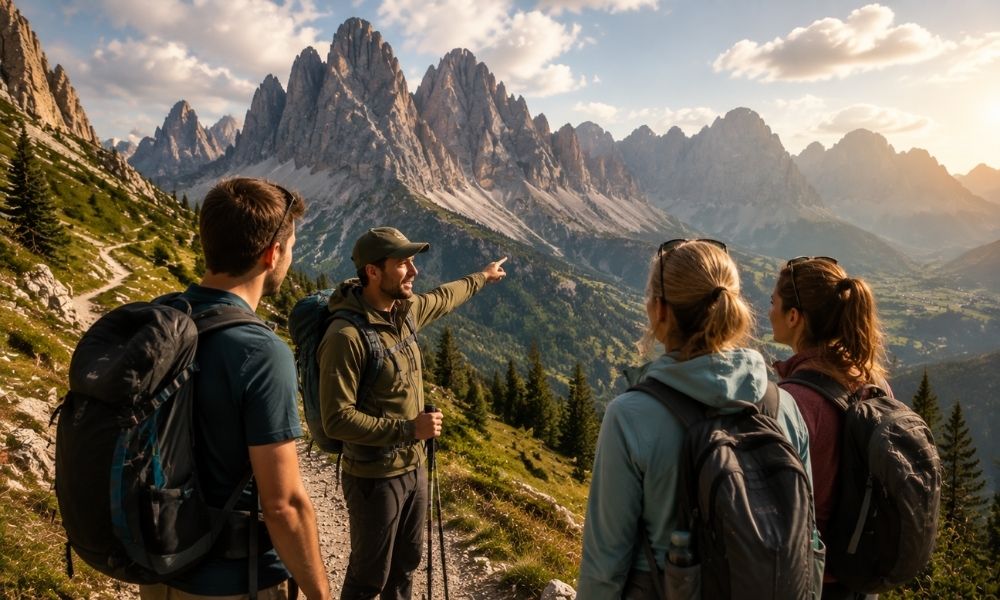
Local guiding helps draw attention to these transitions.
On a western Dolomites journey, Lake Carezza may be one highlight, but the progression through the Ega Valley, Fassa Valley, Pordoi Pass and Val Gardena explains the geography around it.
Similarly, an eastern Dolomites tour is not simply a race from Cortina to Lake Braies. Gardena, Valparola and Falzarego passes provide the dramatic connection between western South Tyrol and the eastern peaks.
This is one of the strongest reasons to travel with someone who knows the area: the spaces between famous stops stop feeling like transfer time.
8. You Can Build a Day Around the Part of the Dolomites You Actually Want to Experience
There is no single “best” Dolomites itinerary because travellers arrive with different priorities.
For Classic Western Dolomites Scenery
Visitors interested in high passes, Lake Carezza and the mountain scenery around Val Gardena can focus on the historic Great Dolomites Road. It is a strong introduction for anyone who wants variety without attempting to cross the entire range in one day.
For Cortina, Tre Cime and Alpine Lakes
The eastern side suits travellers whose priority is Cortina d’Ampezzo and the celebrated lake-and-peak landscapes around Misurina, Dobbiaco, Braies and Tre Cime.
For the Broadest Possible One-Day Overview
Travellers with just one available day may prefer the Best of the Dolomites in One Day, which combines western and eastern highlights in a longer itinerary.
The advantage of doing such an ambitious route with a local driver-guide is obvious: instead of trying to coordinate hundreds of kilometres of mountain driving yourself, you can concentrate on the experience.
For Seceda and the Funes Valley
Photographers and travellers drawn to the Odle peaks can choose an itinerary combining Seceda with Val di Funes.
The Mount Seceda and Funes Valley tour is particularly interesting because it presents the same mountain group from different perspectives: first from the high panoramic area reached from Ortisei and later from the celebrated valley views around Santa Maddalena and San Giovanni in Ranui.
That creates a much richer visual story than visiting either location independently.
9. Local Recommendations Can Improve the Smaller Moments of the Day
A memorable mountain trip is rarely defined only by its biggest landmark.
It may be the place where you stop for lunch, the point where everyone gets out of the vehicle for an unexpected view or the explanation that finally helps you understand why neighbouring valleys feel culturally different.
These decisions are difficult to research from abroad because they depend on context.
A restaurant that makes sense for one route may be inconvenient on another. A viewpoint can be beautiful but inefficient if reaching it adds too much time. A stop that looks essential online may be less rewarding under the day's weather conditions.
Local recommendations work because they are made within the context of the actual journey.
They help turn a generic itinerary into a day that feels connected to the region.
10. A Driver-Guide and a Mountain Guide Serve Different Purposes
Choosing the correct type of guide is important.
Ciao Dolomites focuses on private driver-guided day tours through South Tyrol and Trentino. This format is ideal for scenic exploration by road, panoramic stops, towns, lakes, cable-car excursions and accessible walks.
That is different from hiring a specialist mountain guide for technical alpine objectives.
If your itinerary involves serious climbing, mountaineering, challenging via ferrata routes or technical backcountry terrain, you should use an appropriately qualified mountain professional for that activity.
For travellers whose main goal is to experience a wide section of the Dolomites comfortably in one day, however, a local driver-guide solves a different—and very common—problem: how to connect the region's best scenery without spending your trip concentrating on transportation.
Is Exploring the Dolomites With a Local Guide Worth It?
For a traveller staying several weeks in the region with a rental car and plenty of flexibility, self-driving can be an enjoyable adventure.
But many visitors do not have that luxury. They have one or two days, a long wish list and little familiarity with the roads.
In that situation, a local guide provides value in ways that go beyond simple transportation. You gain a carefully connected route, local interpretation, flexible decision-making and the freedom for everyone in your group to experience the scenery.
Perhaps most importantly, you are less likely to leave the Dolomites remembering the logistics more clearly than the mountains.
The Best Dolomites Trips Are About More Than Reaching the Viewpoint
The Dolomites do not need much help being impressive. The question is whether your limited time in the mountains is spent simply reaching famous places or genuinely understanding and enjoying the journey between them.
A local guide makes that journey easier to connect.
You can see how Val Gardena relates to the Sella Group, why the high passes shape the route, how the cultural identity changes between valleys and which combination of landmarks makes sense within the time available. At the same time, you remove much of the responsibility for navigation, parking and mountain driving.
That advantage is likely to become even more valuable as the Dolomites continue attracting visitors and popular locations rely increasingly on seasonal transport, managed access and careful trip planning.
For travellers who want to make a day in the mountains feel like an experience rather than a logistical exercise, exploring the Dolomites with a knowledgeable local driver-guide is one of the most effective choices they can make.
Frequently Asked Questions
Is a local guide in the Dolomites worth it if I already have a rental car?
Yes, particularly if your time is limited. A rental car gives you independence, while a local driver-guide removes navigation and driving responsibilities and helps organise multiple destinations into a realistic route.
What type of guide does Ciao Dolomites provide?
Ciao Dolomites offers private day tours with a licensed local driver-guide for the Dolomites of South Tyrol and Trentino, with tours conducted in English and Italian.
Which Dolomites tour is best if I only have one day?
If your priority is seeing the broadest range of highlights, the Best of the Dolomites in One Day itinerary combines western and eastern areas. Travellers who prefer a shorter or more focused day can choose a western, eastern or Seceda–Funes itinerary instead.
Can a private Dolomites tour be adjusted to my pace?
Yes. Private tours offer more flexibility than fixed large-group excursions, making them suitable for families, couples, photographers and groups that want to spend more time at particular stops.