
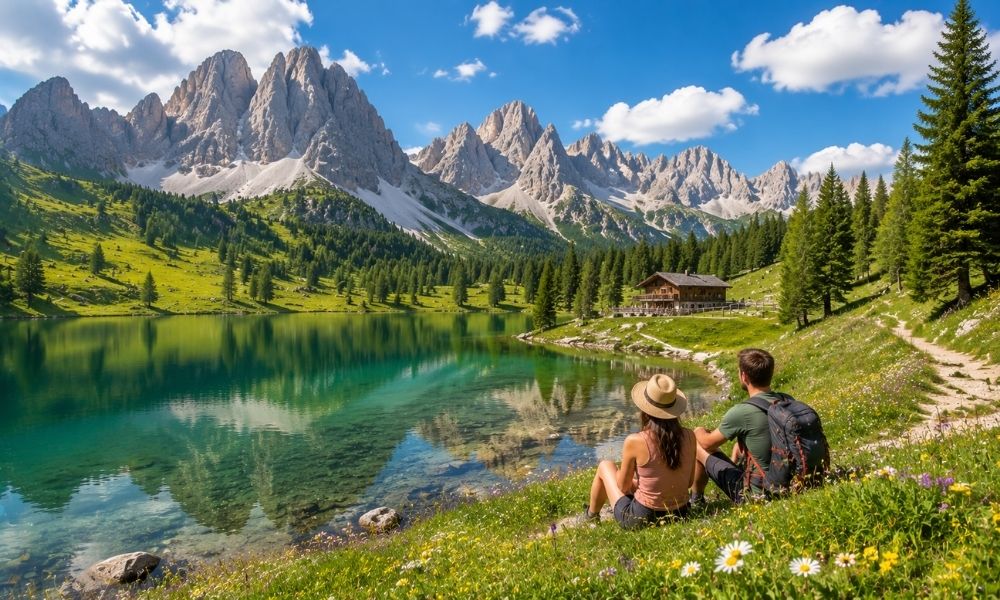
Summer in the Dolomites is easy to underestimate. On a map, a lake, a mountain pass and an alpine meadow can look close enough to combine without much thought. In reality, winding roads, changing weather, busy viewpoints and the temptation to stop every few kilometres can quickly turn a beautiful day into a rushed one.
The best summer days here are not about collecting as many famous places as possible. They are about contrast: still water early in the morning, open meadows under the midday sun, cool air at a high mountain pass and enough unplanned time to stop when the landscape demands it.
That contrast is what makes the Dolomites particularly rewarding in summer. The pale limestone peaks rise abruptly above forests and grasslands, creating the distinctive scenery for which the UNESCO-listed mountain range is known. Instead of choosing between sightseeing and spending time outdoors, visitors can often experience both in the same day.
Begin the Day Beside a Dolomites Lake
A mountain lake is one of the best places to begin a summer day because the atmosphere changes quickly as the morning develops. Early light is softer, the water is generally calmer and popular locations feel very different before the main flow of daytime visitors arrives.
The Dolomites have several famous lakes, but they do not all offer the same experience.
Lake Carezza Is Ideal for a Western Dolomites Day
Lake Carezza, beneath the Latemar massif, works particularly well when travelling from Bolzano toward the western Dolomites. Its attraction is not its size but its setting: coloured water, forest and sharp mountain towers compressed into one remarkably compact landscape.
The water level varies naturally because the lake is supplied by snowmelt and underground springs, while the still surface can create the reflections for which Carezza is famous.
Rather than treating it as a quick photograph from the roadside, allow time to walk around the lake and notice how the view changes through the trees. From here, the journey can continue naturally toward Val di Fassa, Passo Pordoi and Val Gardena.
Travellers starting in Bolzano can follow the same landscape sequence on the Great Dolomites Road route with Ciao Dolomites, which connects Lake Carezza with some of the western range's most memorable passes and valleys.
Misurina and Dobbiaco Offer a Quieter Kind of Beauty
Farther east, Lake Misurina creates a broader mountain scene. Its open shoreline and views toward the surrounding Dolomite groups make it an appealing pause between Cortina d'Ampezzo and the Tre Cime area.
Lake Dobbiaco has a different character again. Forest, wetlands and mountains meet around the water, and the lake is notable as a rare alpine water-meadow habitat as well as a stopping place for migratory birds.
These eastern lakes are particularly satisfying when they are treated as parts of a journey rather than isolated destinations. Driving between them reveals changing valleys, forests and mountain walls that would be missed if the entire day were built around one viewpoint.
Lago di Braies Rewards Good Timing
Lago di Braies is famous for good reason. The lake sits beneath Croda del Becco, with clear water enclosed by forest and steep rock. Walking even part of the shoreline provides a much fuller impression than staying around the boathouse and main arrival area.
Its popularity, however, makes planning important. For summer 2026, access to the Braies Valley is regulated from 1 July to 15 September between 9:00 a.m. and 4:00 p.m. During those hours, visitors must arrive by public transport, on foot or bicycle, or have the required online reservation or permit.
That makes Braies a good example of a broader lesson for summer travel in the Dolomites: arriving at the right time often improves the experience more than adding another destination.
For travellers who want to combine Braies with Misurina, Dobbiaco, Cortina and the surrounding peaks, the Heart of the Dolomites route follows this eastern side of the range from Bolzano.
Walk Through the Meadows Instead of Only Looking at Them
The green slopes beneath the Dolomite peaks are not simply empty foreground for mountain photographs. Many are working alpine pastures shaped by generations of farming, grazing and haymaking.
That becomes especially obvious around Seceda and the Odle/Geisler mountains.
Seceda Shows the Dolomites' Two Personalities at Once
Seceda is one of the clearest examples of what makes summer here different from winter. On one side, the Odle peaks rise in an abrupt wall of rock. On the other, the landscape rolls away through open green pastures.
More than a hundred species of alpine flowers can occur across the summer meadows, while traditional haymaking continues to play a role in maintaining the landscape. Visitors are therefore asked to remain on marked trails rather than cutting across the grass.
You do not need to undertake a demanding mountain ascent to experience the area. From Ortisei, lifts make the high country accessible, after which walking routes range from short panoramic outings to longer hikes through alpine pastures and toward mountain huts.
A summer day combining the Seceda ridge with the meadows and villages of Val di Funes creates a particularly strong contrast. Ciao Dolomites' Mount Seceda & Funes Valley itinerary combines the high viewpoint with the quieter valley scenery around Santa Maddalena and San Giovanni in Ranui.
Val di Funes Is Worth Experiencing Slowly
Val di Funes is frequently photographed because of its churches beneath the Odle peaks, but the valley deserves more than a camera stop.
Walking here brings you closer to the scale of the landscape. Farmhouses, forest edges, hayfields and the mountains all occupy different layers of the view. The official South Tyrol tourism information describes summer in the area in terms of alpine meadows, forest shade, streams and trails crossing working pastures.
This is one of those places where a simple half-hour walk can add more to the day than another hour behind the wheel.
Go Higher When You Want the Mountain Air to Change the Day
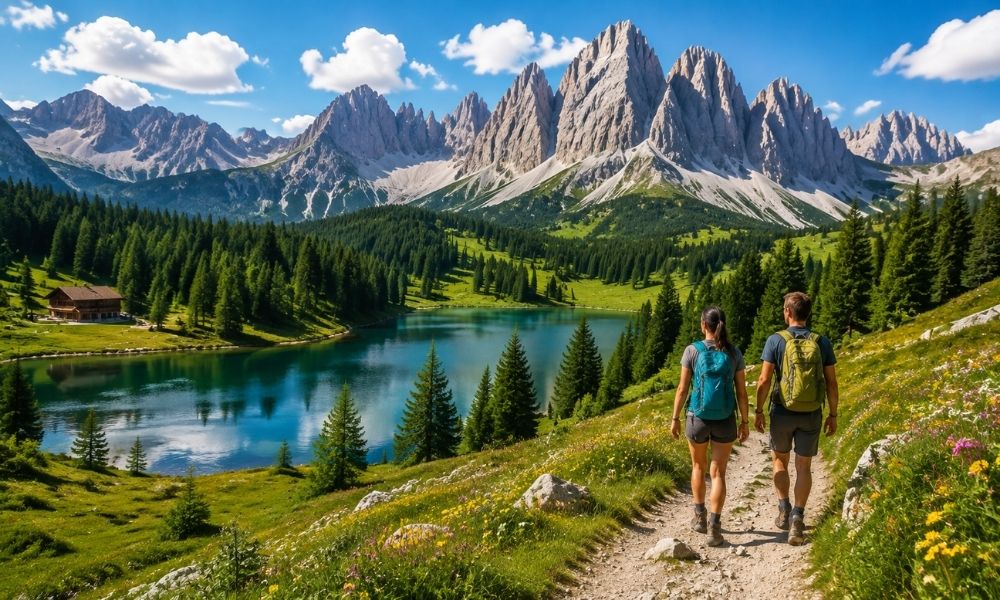
Summer temperatures in the valleys can feel warm, particularly around midday. Drive toward Passo Gardena, Passo Sella or Passo Pordoi, however, and the atmosphere changes remarkably quickly.
The roads climb above forests and into open mountain terrain where the rock feels much closer and the air is noticeably cooler. This is where the Dolomites begin to feel less like scenery around you and more like a landscape you are inside.
Passo Pordoi is particularly dramatic. The road reaches 2,239 metres, while a seasonal cable car can continue to Sass Pordoi at approximately 2,950 metres. Ciao Dolomites includes the pass on its western and full-range itineraries.
You do not need to turn every pass into a long hike. Sometimes the best use of an hour is simply to walk away from the parking area, find an open viewpoint and sit long enough for the scale of the mountains to register.
Build a Summer Day Around Rhythm, Not Distance
A good Dolomites itinerary should become slower as the day progresses rather than more frantic. One practical pattern is:
- Early morning: choose one important lake and enjoy it before the busiest part of the day.
- Late morning: continue toward a meadow, valley or cable-car-accessible walking area.
- Lunch: stop at a rifugio, mountain hut or village rather than eating while rushing between sights.
- Afternoon: cross one or two mountain passes, leaving room for spontaneous viewpoint stops.
- Late afternoon: finish somewhere that does not depend on perfect midday conditions—perhaps a valley walk, village or scenic return through the mountains.
Trying to combine Lake Carezza, Seceda, Tre Cime and Lago di Braies in an ordinary sightseeing day would mean spending much of the experience in transit. If time is genuinely limited, it makes more sense to accept that the day will be a panoramic overview. The Best of the Dolomites in One Day tour is designed around exactly that idea, connecting the western and eastern highlights on one long route from Bolzano.
Otherwise, divide the range into western and eastern days.
Prepare for Mountain Weather Even on a Clear Morning
Summer in the mountains should never be treated like summer at sea level. Conditions can change within hours, and temperature, wind and rainfall become more significant as altitude increases.
Local mountain guidance recommends checking the forecast carefully, leaving early, understanding the length and difficulty of your intended walk and carrying layers as well as waterproof protection.
For an ordinary sightseeing and light-walking day, bring:
- Comfortable shoes with reliable grip rather than smooth city footwear.
- A light waterproof layer and something warm for higher passes.
- Water, sun protection, sunglasses and a hat.
- A small daypack so your hands remain free on trails.
- An offline map or saved route information where mobile coverage may be unreliable.
- Enough flexibility to shorten or change the route if clouds build over the mountains.
The aim is not to overpack. It is to avoid having a beautiful high-altitude stop cut short because the temperature is ten degrees cooler than expected or a short shower arrives.
Leave Space for the Rifugio Experience
A summer day in the Dolomites is incomplete if every meal is treated as a logistical interruption.
Mountain huts are part of the landscape. Around Seceda alone, numerous family-run huts and alpine restaurants serve a mix of South Tyrolean, Italian and Ladin dishes.
Stopping for lunch also solves a practical problem: it forces the itinerary to slow down.
After walking through high meadows, sitting outside with a plate of local food, an espresso or a cold drink while looking toward the mountains often becomes more memorable than another scheduled viewpoint.
That is particularly true for travellers accustomed to city sightseeing, where efficiency tends to be rewarded. In the Dolomites, the opposite is often true. The more tightly the day is scheduled, the easier it is to miss what makes the place special.
Respect the Landscape That Creates the Experience
Summer tourism puts pressure on exactly the places visitors have come to enjoy. Lago di Braies now uses seasonal access controls, while popular alpine areas encourage visitors to use public transport and remain on designated trails.
Responsible behaviour does not require complicated rules. Do not walk through hay meadows for a photograph. Do not leave the marked path simply to avoid another group. Carry out waste. Respect livestock and private land. Use buses and lifts when they make sense.
Most importantly, consider timing. A famous place visited early or later in the day can feel entirely different from the same place at its busiest hour.
Summer in the Dolomites Is Best When You Stop Trying to See Everything
The most rewarding summer days in the Dolomites usually contain fewer places than travellers originally planned.
One clear lake in the morning, an hour walking through alpine grass, lunch with a mountain view and an afternoon crossing a high pass can reveal far more about the region than a checklist of ten hurried photo stops.
Lake Carezza shows the intimate side of the mountains. Braies, Misurina and Dobbiaco reveal how water changes the character of the eastern valleys. Seceda and Val di Funes show that the famous green meadows are living cultural landscapes. Pordoi and Gardena bring you into colder, higher mountain air where the scale of the Dolomites becomes impossible to ignore.
As visitor management becomes increasingly important at popular locations, thoughtful timing and well-planned transport will matter even more. That is not a disadvantage. It is an invitation to travel through the Dolomites more deliberately—giving lakes, meadows and mountains enough time to become experiences rather than backgrounds for photographs.
FAQs
What is the best month for a summer visit to the Dolomites?
July and August offer broad access to lifts, mountain huts and high-altitude routes, but they are also the busiest months. June can be excellent for green landscapes and flowers, while September often combines pleasant hiking conditions with fewer visitors. Conditions at higher elevations should always be checked before setting out.
Which Dolomites lake is best for a first visit?
Lake Carezza is convenient for travellers exploring the western Dolomites from Bolzano. Lago di Braies is the iconic eastern choice, while Misurina and Dobbiaco are excellent when combining several sights around Cortina and the Three Peaks area.
Can I visit the Dolomites without doing difficult hikes?
Yes. Scenic roads, cable cars, short lakeside walks and easy meadow trails provide access to exceptional views without demanding trekking. Seceda, Passo Pordoi and several major lakes are particularly suitable for combining sightseeing with shorter walks.
What should I wear in the Dolomites during summer?
Dress in layers. Even on a warm valley day, high passes and mountain viewpoints can be cool or windy. Comfortable walking shoes, sun protection, a warm layer and a lightweight waterproof jacket cover most ordinary sightseeing and easy-hiking situations.