Planning a Dolomites road trip looks deceptively simple on a map. Villages appear close together, mountain passes seem like convenient shortcuts, and it is tempting to build a day around covering as many famous places as possible.
That approach usually misses what makes driving here special.
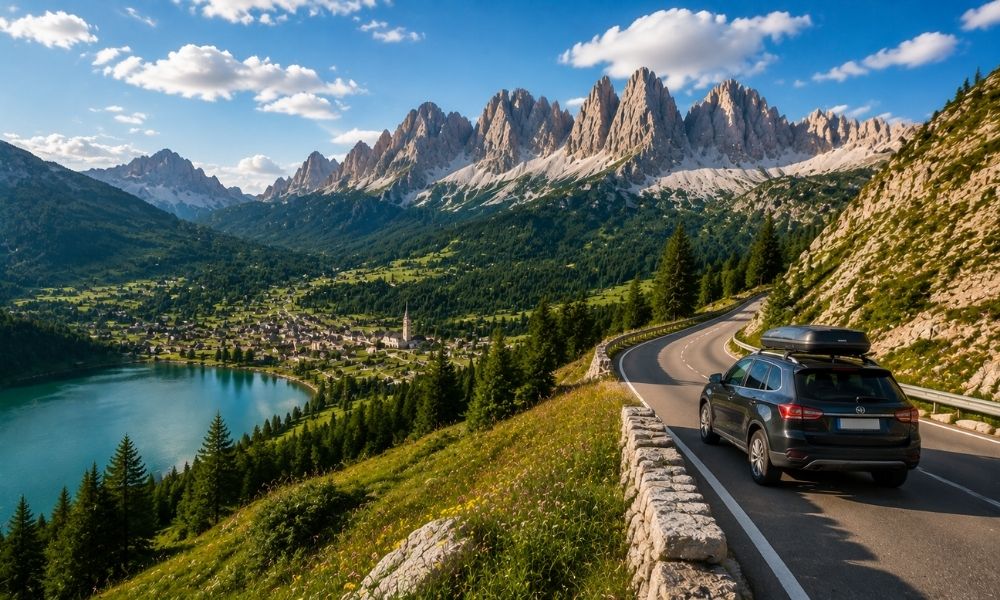
In the Dolomites, the road is part of the experience. A short distance can involve hairpin bends, high passes, cyclists, sudden viewpoints and stops that deserve far longer than expected. Scenic-minded travellers are usually better served by driving fewer kilometres and choosing roads where the landscapes keep changing.
The following Dolomites road trip ideas focus on exactly that: routes worth driving for the journey itself, with enough flexibility to stop when the light, weather or view gives you a reason.
1. Drive the Great Dolomites Road for the Classic First-Timer Experience
For a first road trip through the region, the western section of the Great Dolomites Road is difficult to improve upon.
A rewarding route from Bolzano runs through the Ega Valley towards Lake Carezza, crosses the Costalunga Pass into Val di Fassa, continues towards Canazei and Passo Pordoi, then returns through the Sella and Gardena area.
Why This Route Works So Well
The appeal is variety rather than a single headline viewpoint.
Leaving Bolzano, the road quickly changes from a relatively urban valley into a narrower mountain corridor. Lake Carezza provides an easy first scenic stop, backed by the Latemar peaks, before the route moves into broader alpine landscapes around Val di Fassa.
The drive then becomes more dramatic.
Passo Pordoi brings the classic Dolomites combination of open pasture, pale rock walls and tightly stacked bends. From there, the scenery around Passo Sella and Val Gardena becomes even more imposing as Sassolungo and the Sella massif dominate the skyline.
Rather than treating the passes as checkpoints, allow time to get out of the car. Ten or fifteen minutes at an unplanned viewpoint can be more memorable than squeezing another attraction into the day.
Travellers who would rather enjoy these roads without concentrating on mountain driving can also see how Ciao Dolomites structures its Great Dolomites Road experience.
Best For
This route suits travellers with one full day who want a balanced introduction to lakes, valleys, famous passes and the unmistakable limestone scenery of the western Dolomites.
2. Circle the Sella Massif on the Four-Pass Loop
If your idea of a scenic road trip involves mountain driving from beginning to end, make the Sella massif the centre of your day.
The classic road circuit links four passes:
- Passo Gardena
- Passo Campolongo
- Passo Pordoi
- Passo Sella
You can join the loop from Selva di Val Gardena, Corvara, Arabba or Canazei, making it especially convenient if you are staying in Val Gardena, Alta Badia or Val di Fassa.
Why Scenic Travellers Should Take It Slowly
What makes this route interesting is that the same mountain group keeps changing character as you circle it.
Around Gardena, enormous rock walls rise almost directly above green slopes. Campolongo feels gentler and provides a transition towards Arabba. Pordoi delivers the classic high-pass drama, while Sella gives especially striking perspectives towards Sassolungo.
Driving the whole circuit simply to say you completed it would be missing the point. Pick two or three longer stops instead.
A coffee at a mountain refuge, a short panoramic walk or an hour spent watching the afternoon light move across the peaks gives the loop more depth than constant driving.
Passo Gardena becomes particularly busy in summer, and parking at the pass is limited. Avoid relying on roadside spaces and consider an early start if photography and quieter viewpoints matter to you.
3. Combine Passo Falzarego, Valparola and Giau from Cortina
Cortina d'Ampezzo makes one of the strongest bases for travellers who prefer rugged high-pass scenery.
A particularly rewarding circuit leaves Cortina towards Passo Falzarego, continues over nearby Passo Valparola towards Alta Badia, turns south towards Arabba and the Andraz area, then returns to Cortina over Passo Giau.
Falzarego and Valparola Add More Than Mountain Views
Falzarego has a different atmosphere from the western passes. The surrounding landscape feels more severe, with the Tofane, Lagazuoi and Cinque Torri giving the road a distinctly rocky character.
Continue a little farther to Valparola and the scene opens towards Alta Badia. The change happens quickly, which is exactly why this area rewards road travel: one pass can completely reorganise the landscape in front of you.
Save Passo Giau for the Finale
Passo Giau deserves to be more than a quick photo stop.
Approaching from the west before descending towards Cortina, the road climbs through forest and pasture before the view suddenly opens around the summit. Monte Nuvolau, Averau, Ra Gusela and distant Dolomite groups create one of the broadest high-altitude panoramas accessible directly by road.
If the weather is clear, give Giau the longest stop of the drive. For photographers, late-afternoon light can transform the scene, although mountain conditions should always take priority over a planned sunset.
This circuit is best for confident drivers comfortable with repeated bends, climbs and descents.
4. Build an Eastern Dolomites Road Trip Around Lakes and Tre Cime
Not every Dolomites road trip needs to revolve around consecutive mountain passes. The eastern Dolomites offer a different style of scenic day, linking Cortina with Misurina, Tre Cime, Dobbiaco and Lago di Braies.
This is a good choice when your priority is seeing iconic landscapes rather than maximising driving excitement.
Start with Cortina and Misurina
From Cortina, head towards Passo Tre Croci and Misurina.
The atmosphere changes quickly as the road leaves the Ampezzo basin. Misurina is worth stopping at because the lake gives you a broad, accessible mountain panorama without requiring a long walk.
From here, travellers can continue towards the Tre Cime di Lavaredo area before heading north towards Dobbiaco.
Tre Cime requires more planning than an ordinary roadside viewpoint. Parking at the Rifugio Auronzo access area currently requires advance reservation, so this is one stop to organise before the morning of your trip.
Continue Towards Dobbiaco and Lago di Braies
After returning from the Tre Cime area, continue towards Dobbiaco and then Lago di Braies.
Braies works best as a deliberately timed stop rather than an improvised detour. Peak-season traffic management limits unrestricted vehicle access during part of the day, and parking availability can be constrained.
For summer 2026, access to the Braies Valley between 9:00 and 16:00 from 1 July to 15 September requires public transport, walking, cycling, an online reservation or a valid transit permit. Regulations can change between seasons, so future travellers should always recheck the current rules.
Ciao Dolomites combines several of these landscapes in its Heart of the Dolomites route, which can also be useful for understanding how the eastern highlights fit together geographically.
5. Choose Val di Funes and Seceda for a Slower Photography-Focused Day
Scenic road trips do not have to involve dramatic driving all day.
For photographers and travellers who care more about composition than hairpin bends, the combination of Val di Funes and Val Gardena provides a slower alternative.
Photograph the Odle from the Valley Floor
Drive into Val di Funes towards Santa Maddalena, where the Odle peaks rise behind meadows, farmhouses and church spires.
The attraction here is not a single pass. It is the relationship between the inhabited valley and the mountains above it.
Because the best viewpoints often require short walks, plan this as a park-and-wander destination rather than a place to photograph through the car window.
See the Same Mountains from Seceda
From Val di Funes, return towards the Isarco Valley and continue towards Ortisei in Val Gardena. From Ortisei, the cable-car system gives access to Seceda, where the perspective changes completely.
Instead of looking up towards the Odle peaks from the valley, you are suddenly standing high alongside their jagged ridgeline.
That contrast is what makes combining the two places so effective. You are not simply seeing two attractions; you are seeing the same mountain system from dramatically different positions.
The Seceda and Funes Valley itinerary follows this same visual logic and is particularly well suited to travellers whose priority is photography rather than covering distance.
6. Loop Around Marmolada via Passo Fedaia, Alleghe and Arabba
For travellers based around Canazei or Val di Fassa, another excellent road-trip idea is to head towards Passo Fedaia beneath Marmolada, descend towards the Agordino side, visit Alleghe and return towards Arabba and Passo Pordoi.
This route feels different from the Sellaronda even though the two are geographically close.
Why the Marmolada Side Feels Different
The landscape around Fedaia has a higher, more austere character. Marmolada dominates the skyline, while the reservoir near the pass gives you a strong contrast between water and rock.
Descending towards Caprile and Alleghe softens the scenery. Forested slopes become more prominent and Lake Alleghe creates another worthwhile pause before the road climbs back towards Arabba.
From Arabba, Passo Pordoi provides a natural way to complete the circuit towards Canazei.
This route is especially appealing if you have already driven the four Sella passes and want a second day that feels genuinely different rather than like a variation of the same loop.
As with every high-level route in the Dolomites, confirm the latest road conditions before setting out.
How to Plan a Dolomites Road Trip for the Views, Not the Mileage
The biggest improvement most travellers can make is simply reducing how much they try to fit into one day.
A scenic Dolomites drive works better when you:
- Start early but leave space in the schedule. Early departures help with traffic and parking, while unscheduled time lets you stop when conditions are particularly good.
- Choose one major region per day. Combining every famous lake and mountain pass usually creates more windshield time than enjoyment.
- Treat viewpoints as stops, not drive-by attractions. Park legally, get out and spend time looking at how the landscape changes.
- Allow mountain weather to change your plan. A lower valley or lake route can be more rewarding than forcing a high pass into cloud or poor visibility.
- Avoid calculating the day from distance alone. Fifty kilometres of alpine roads can feel much longer than fifty kilometres on a motorway.
One carefully planned loop is usually more satisfying than spending the day racing between unrelated Instagram locations.
Check Access and Road Conditions Before Leaving
The Dolomites are easy to explore by road in good conditions, but the environment is increasingly managed around congestion, parking pressure and seasonal demand.
Before setting off, check:
- Mountain-pass conditions: storms, snow, roadworks and temporary event closures can alter a route quickly.
- Parking requirements: famous sites such as Tre Cime may require advance reservations.
- Peak-season access rules: Lago di Braies is a notable example of a destination with seasonal traffic management.
- Cable-car operating periods: if your drive depends on reaching Seceda or Sass Pordoi, confirm the lift timetable separately from the road status.
- Your return route: never assume the next pass will remain the fastest way back if conditions deteriorate.
Official road-information services are more valuable on the morning of the trip than a route saved months earlier.
When Is the Best Time for a Scenic Dolomites Road Trip?
For a road trip built around high passes, the warmer snow-free months provide the greatest flexibility.
June can offer fresh green landscapes and long daylight, although some high-altitude facilities may still be transitioning into their summer season. July and August generally provide the widest range of options but also bring the heaviest traffic around famous passes and lakes.
September is particularly attractive for scenic-minded travellers. The busiest holiday period begins to ease, visibility can be excellent and high routes are often still accessible when weather cooperates.
By October, autumn colours can be beautiful in the valleys, but travellers should build much more flexibility into high-pass plans.
Winter is a different type of trip entirely. Snow, winter-equipment requirements and changing pass conditions mean that a summer-style multi-pass itinerary should never simply be copied into January or February.
The Best Dolomites Road Trip Is the One You Have Time to See
The Dolomites reward restraint.
A successful scenic road trip is not the itinerary with the greatest number of famous names attached to it. It is the one that gives you enough time to watch Sassolungo appear around a bend, walk beside Lake Carezza, linger at Passo Giau or change your plans because the light over the Odle suddenly becomes too good to leave.
For first-time visitors, the Great Dolomites Road provides the best broad introduction. The Sella loop is ideal for pass lovers, Cortina offers some of the region's most dramatic high roads, and the eastern lakes provide an excellent alternative when scenery matters more than continuous mountain driving.
Access management around the most popular Dolomite landmarks is likely to remain an increasingly important part of trip planning. That makes flexibility even more valuable. Think of the car as a way of connecting exceptional landscapes rather than a tool for collecting as many stops as possible.
Drive less, stop more, and let the mountains determine the pace.
FAQs
How many days do you need for a Dolomites road trip?
Three to five days gives you enough time to experience several distinct areas without rushing. Within one day, choose a single major loop such as the Great Dolomites Road or the Sella passes.
Do you need a 4x4 to drive in the Dolomites?
No. The main scenic passes are paved public roads, and a normal car is suitable in ordinary snow-free conditions. Winter driving is different and requires appropriate equipment and current road checks.
Are the Dolomite mountain roads difficult to drive?
They are generally well surfaced, but some passes have repeated hairpin bends, steep descents, cyclists and busy summer traffic. Drivers uncomfortable with mountain roads should plan shorter routes or consider travelling with a local driver.
Do you have to pay to drive through the Dolomites?
Most ordinary mountain-pass roads are not toll roads, although motorway tolls, parking charges and special access arrangements may apply. Tre Cime, Braies and other heavily visited locations can have separate parking or reservation requirements.
What is the best month for a Dolomites road trip?
September is an excellent balance for many scenic travellers because summer crowds often ease while high mountain roads may still be accessible. June is another strong option. July and August offer maximum summer access but are generally busier.